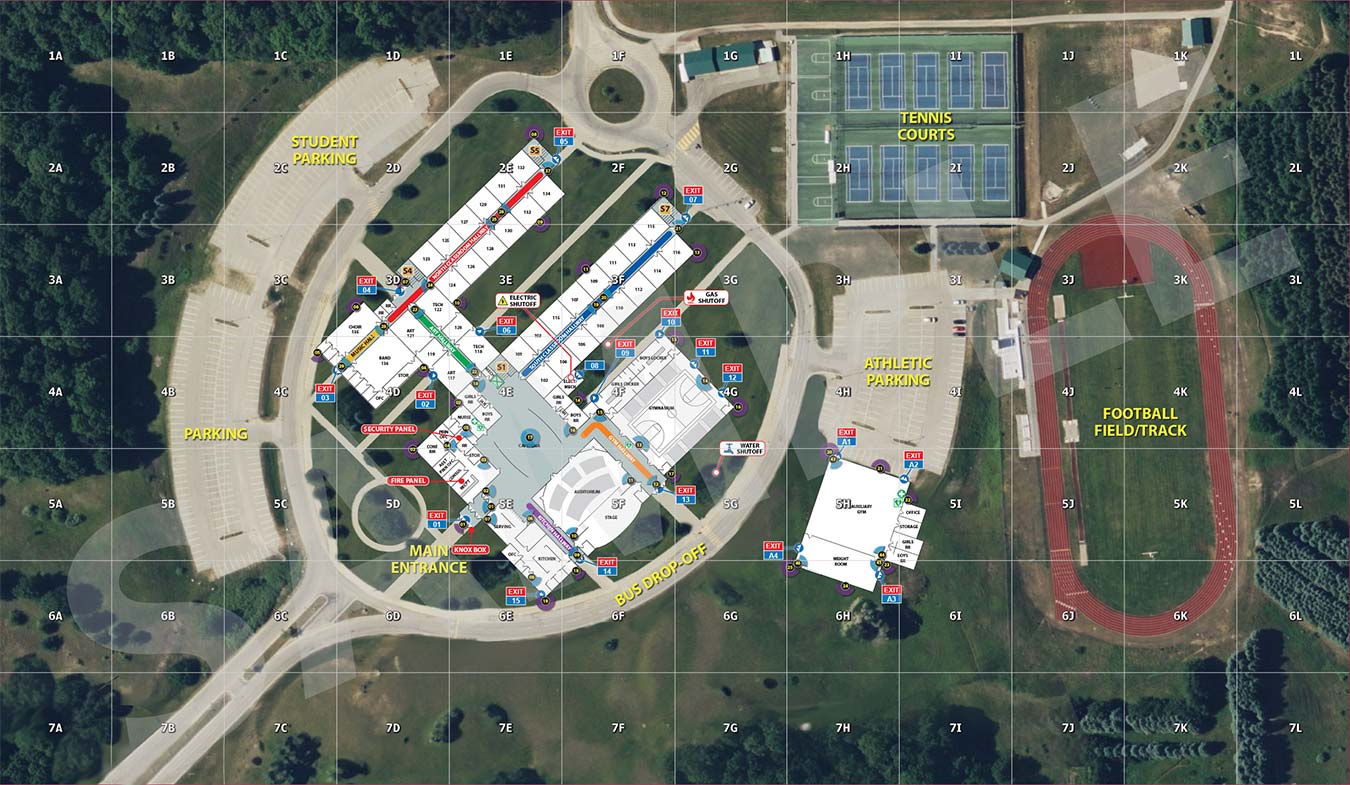
From the moment an emergency occurs, every second counts. In an effort to locate, understand, and manage critical incidents, first responders rely on accurate and consistent information presented in Critical Incident Maps. These tools, also known as CIMs, provide clarity during chaos—but clarity alone isn’t preparedness.
What are critical incident maps?
To better understand the role Critical Incident Maps play in emergency planning, we can start with the basics. Here are five foundational things to know about CIMs:
- They are a satellite image of a location, aligned to true north, with a building’s floorplan overlaid.
- A gridded coordinate system using alphanumeric labeling provides clear location identification.
- CIMs are mainly used by dispatchers and first responders during an emergency.
- They include important information such as building exits, room numbers, and stairwell labels.
- Critical incident maps are a singular part of a larger safety mapping plan, not the end-all be-all.
Review our previous blog post, Critical Incident Mapping for Schools, for a deeper understanding of the elements that make up this resource.
Rooted in military strategies for gridded reference graphics, or GRGs, elements of critical incident maps have existed across various institutions for years. Through the combined efforts of the NAPSG Foundation, veterans, and safety map producers, these elements were merged and modernized to provide instant location data for quick response.
With the increase of emergency events over the past decade, state-level legislation has provided grant funding for critical incident map creation in schools. As a result, many institutions and industries have shifted focus toward these maps, assuming they will be the only resources needed during an emergency—when, in reality, it could leave gaps where other important safety information may fall through.
One piece of the emergency toolkit
While vital to dispatch and first responders, Critical Incident Maps don’t fully equip an emergency response strategy unless they are built into a full suite of safety mapping. At Building Maps, we understand every step of the process and know that many elements go into the development of CIMs. We study local and national laws that shape industry standards and develop the floor maps that support CIM creation.
Alongside fire evacuation and severe weather, critical incident maps are invaluable in most schools, hospitals, and manufacturing plants. These resources support a more comprehensive approach to keeping buildings—and the people inside them—safe.
How the building maps safety suite works together
The experts at Building Maps know how to compile comprehensive and accurate Emergency Operations Plans (EOPs). We’re here to support you in organizing a complete suite of safety maps that helps tell the whole story.
Building maps: your partner in emergency planning
Critical Incident Maps are powerful—but they’re only one part of a comprehensive safety map suite. When it comes to protecting students, healthcare professionals, patients, and employees, don’t rely solely on one resource.
Building Maps creates all-hazard, safety maps that support your Emergency Operations Plan. We will help you assess what is needed and provide clear direction on how to create or update necessary materials. This approach supports effective maps, comprehensive training, and peace of mind.
Contact us today to talk to an expert so we can walk you through our collection of safety solutions. Building Maps creates layered strategies that ensure critical resources are in place when they’re needed most. From the moment an emergency occurs, people are guided, first responders are informed, and lives are protected.