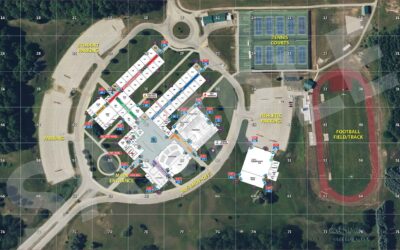
You want to protect the safety of people using your building, so you’ve done everything right. You checked and complied with local codes. You have an OSHA emergency action plan. And you have accurate, up-to-date facility emergency maps.
What you do with those maps could make all the difference: Proper placement of every building evacuation map is essential to an effective emergency safety plan.
For an emergency evacuation map to work as intended — guiding people to safety — it must be placed in the correct location. Just as important, it must be oriented so people can quickly understand it.
And those details are not as straightforward as they seem.
Different buildings, different needs
First, a building evacuation map must be visible. It should be posted in a conspicuous, well-lit space.
Other considerations include the size of the building, how it is used, and the requirements of local fire codes. It’s always best to consult with local authorities or an expert like Building Maps to determine the proper placement. But here are some general considerations:
Manufacturing or industrial facilities:
Emergency evacuation maps should be posted at stairwells, elevators and information centers, such as bulletin boards. It’s also important to also post maps in areas where the exits are not immediately visible or obvious. Note also that if the building is large, the maps should be made in a font large enough to be understood from a distance.
Schools
Every classroom needs a map by the door. The same goes for every stairwell and elevator. Beyond that, it’s also important to consider how visitors use school spaces — such as for public events or sports. Auditoriums, gyms, libraries, locker rooms, and event spaces are examples of spaces that need a building evacuation map.
Office Buildings
Conference rooms, stairwells and elevators should have emergency evacuation maps. Even if employees are familiar with the building, that does not mean they know which exit is closest, so it is important to put maps in areas where exits are not obvious. It’s also smart to post maps in high-traffic areas, such as break rooms and near bulletin boards.
Hotels & Healthcare:
In these buildings, the guests and visitors often significantly outnumber people who know their way around. Every guest or patient room needs an evacuation map near the door. Building entrances, elevators, and stairs are also priority locations. Every conference room and every event room should have a map near each door.
Retail Stores & Restaurants:
In addition to all entrances and restrooms, other important locations for maps are break rooms or central information centers that employees use.
Which way is up?
It’s a common misconception that the top of a map should point north. However, that is not the way people view maps. Most of us perceive the top of the map as aligning with the direction we are facing.
If a map is improperly oriented, the user will have to mentally rotate the direction. This can cost precious seconds. The last thing you want in an emergency is someone trying to figure out which way is up and wondering where they should be looking for an emergency egress route.
The proper orientation of the map depends on where it will be posted. For example, a room with four walls would potentially have four different orientations. And that can quickly get complicated, especially for larger buildings, angled spaces or multiple map needs.
It’s also not as simple as rotating the map within a frame. All text, images and symbols must also be rotated to the appropriate orientation for each map location.
The map orientation also may be subject to local fire codes. Compliance with local regulations often gets overlooked by organizations who try to illustrate their own safety maps.
Working with an experienced map designer like Building Maps can ensure proper safety map orientation — and result in maps with simple and clear illustrations.
Avoid the pitfalls: Request a free quote
As the industry leader in creating and maintaining safety maps, the Building Maps team is trained not just in illustration but also in building safety.
We work with organizations across the country, in every industry sector, and are well-versed in codes and standards of the National Fire Protection Association (NFPA), the International Code Council (ICC), and the Occupational Safety and Health Administration.
Working with Building Maps will provide confidence that your emergency planning efforts will not be wasted. Make sure your emergency safety plan is executed the right way — with facility emergency maps that are properly placed and oriented.
Contact us today by phone or email. Or tell us a little bit about your project to request a quick and free quote.